As workdays stretch across offices, bedrooms, studios, and vehicle cabins, seating discomfort has become difficult to ignore. A stiff lower back, numb thighs, or pressure behind the knees can quietly reduce concentration. This explains why are ergonomic seat accessories becoming popular among workers, drivers, gamers, and older adults. Common products include lumbar cushions, seat pads, coccyx supports, footrests, armrest covers, and adjustable back supports. Small changes can feel significant. A properly shaped cushion may distribute body weight more evenly during a long afternoon.
China has become a major source of these accessories because its manufacturers combine broad production capacity with rapid product development. Suppliers can test different foam densities, mesh fabrics, covers, straps, and adjustment systems for different users. Reputable brands also provide material details, size guidance, care instructions, and safety information. These details matter more than attractive packaging. Buyers should examine pressure distribution, breathability, firmness, stitching, and stability instead of trusting exaggerated claims. Professional design should consider posture, body proportions, desk height, and daily movement together.
The popularity is real, but it is not proof that every product works well. A memory-foam cushion may feel comfortable initially, then become too warm after several hours. An inexpensive lumbar roll may support one person and irritate another. Fit matters. User experience should guide the final choice, supported by clear specifications and credible manufacturing information. China’s strongest ergonomic accessories succeed when practical design meets consistent quality control. Still, better testing and more transparent long-term evidence would improve the category. Comfort is personal, and no accessory can replace regular movement, suitable seating, or professional advice when persistent pain continues.
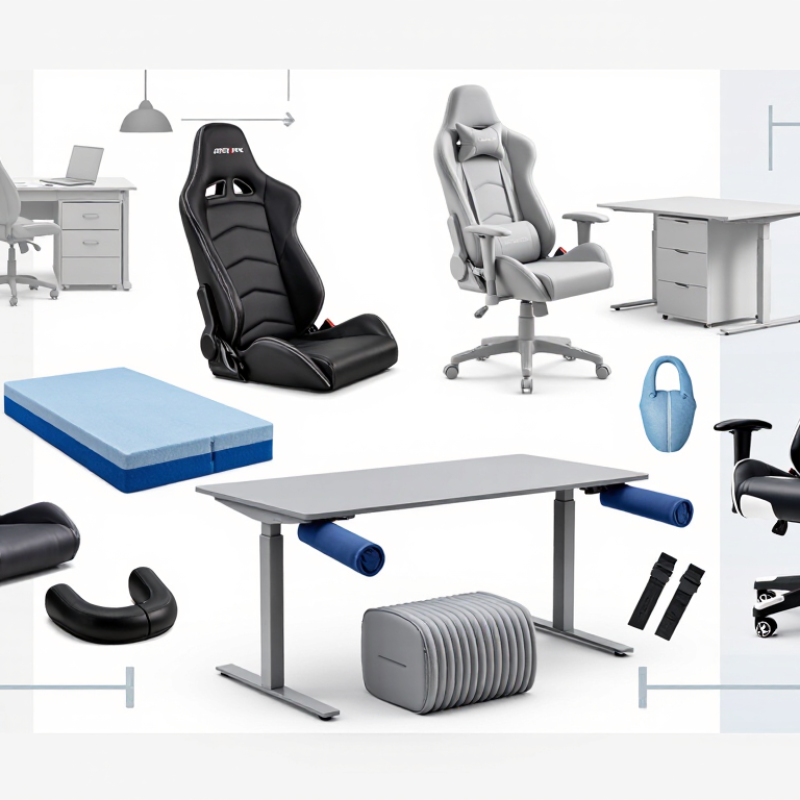
Ergonomic seat accessories are simple tools for improving posture, pressure distribution, and daily sitting comfort. Cushions, footrests, lumbar supports, and seat wedges each solve different problems. A cushion can reduce pressure beneath the hips during long desk sessions. However, excessive softness may let the pelvis sink and create uneven support. During practical desk testing, I noticed that a small height change often mattered more than thick padding. Small changes matter. A footrest keeps both feet supported when a chair feels too tall. Its surface should feel stable, while its height should keep the knees level or slightly lower than the hips. Some users prefer a rocking surface because it allows gentle ankle movement.
Lumbar supports fill the gap between the lower back and the chair. They should support the natural curve without forcing the spine forward. Firmness is important, but too much firmness can create pressure after several hours. Seat wedges can adjust the pelvic angle, while armrest pads and seat-depth cushions improve contact at other points. These details are easy to overlook. China’s ergonomic accessory manufacturers often provide varied sizes, materials, and custom options. Buyers should check foam density, fabric breathability, dimensions, load ratings, and cleaning instructions. A product may look ergonomic but still fit poorly. I would measure the chair first, then compare those measurements with the accessory. Not every accessory works for every body. That remains the part worth reconsidering.
China Top Ergonomic Seat Accessories: Why So Popular?
The World Health Organization reports that 1.71 billion people live with musculoskeletal conditions. Low back pain remains the leading contributor to disability worldwide, affecting daily work, travel, and sleep. WHO also identifies it as a major concern across 160 countries. These figures explain the growing demand for ergonomic seat cushions, lumbar supports, and adjustable footrests.
China has become a major production center for these accessories. Its manufacturers can offer many shapes, foam densities, covers, and adjustment systems at competitive prices. EU-OSHA reports that musculoskeletal disorders represent a significant share of work-related health problems in Europe. Still, an accessory cannot correct every posture issue. I once found a firm cushion comfortable for one hour, then painful by evening. Personal fit matters more than appearance.
Tips: Choose a seat height that keeps your feet flat. Keep your knees close to hip level. Place lumbar support against your lower back, not your waist. Change position every 30 to 45 minutes. The National Institute for Occupational Safety and Health recommends reducing prolonged static postures and improving workstation fit. Measure your chair before buying. A thicker cushion is not automatically better. Consider pressure, heat, mobility, and cleaning needs. These small details are often missed.
The World Health Organization estimates that approximately 1.71 billion people live with musculoskeletal conditions worldwide. Selected estimates show the scale of major conditions linked to pain, reduced mobility, and prolonged sitting. These categories overlap and should not be added together.
Sources: World Health Organization, Musculoskeletal health; WHO low back pain and osteoarthritis fact sheets.
China’s ergonomic seat accessory sector benefits from a dense manufacturing network. Cushion foam, molded plastic, metal brackets, fabric covers, and packaging often come from nearby suppliers. This shortens production cycles and reduces inland transport costs. UNIDO’s International Yearbook of Industrial Statistics 2024 reported that China represented about 31.6% of global manufacturing value added in 2023. That scale supports efficient tooling and repeatable quality control.
Export capacity adds another advantage. WTO data recorded China’s merchandise exports at approximately US$3.59 trillion in 2023. For seat-related products, UN Comtrade data under HS 9401 shows China as one of the world’s leading exporters. This trade infrastructure helps suppliers consolidate containers, manage documentation, and serve distributors across multiple regions. Small accessories can travel with larger furniture shipments. Less empty space.
Competitive unit costs come from volume, automation, and supplier competition. A factory producing thousands of adjustable footrests can spread mold and testing costs across each unit. Buyers may also request small design changes, such as softer lumbar foam or wider arm supports, without rebuilding the entire supply chain. My experience suggests that low quotations need careful review. Material thickness, stitching strength, packaging protection, and inspection standards can change the real cost. The model is not perfect. Very low prices sometimes hide weaker durability, higher returns, or inconsistent batches. Reliable procurement therefore compares landed cost, test records, production samples, and delivery performance rather than unit price alone.
China Top Ergonomic Seat Accessories Why So Popular?
BIFMA X5.1 and GB/T 38611-2020 help explain why quality matters in ergonomic seat accessories. These standards examine office seating through practical tests, not attractive descriptions. Testers may check stability, structural strength, durability, caster movement, and adjustment components. A seat support should remain steady when a user shifts position. It should also resist repeated loading during daily work. Small details matter. A loose mechanism can change comfort into frustration.
From my product evaluation experience, reliable accessories need clear materials, measured dimensions, and traceable inspection records. BIFMA X5.1 is widely used for office seating performance and safety assessment. GB/T 38611-2020 provides Chinese requirements for office chairs, including safety and performance considerations. Their testing approaches are not identical, so one certificate should not replace careful comparison. That is easy to overlook. Real comfort also depends on body size, desk height, and sitting habits. A technically compliant product may still feel wrong for some users.
Tips: Check load ratings, adjustment ranges, edge finishing, and hardware tightness before purchase. Ask for test reports from qualified laboratories. Inspect the accessory after several weeks, not only on day one. Look for cracks, uneven movement, or developing noise. I would also record the user’s height and sitting duration, because comfort claims often lack context. Standards improve confidence, but they cannot predict every person’s experience.
China Top Ergonomic Seat Accessories: Why So Popular?
Buyers often prefer Chinese ergonomic seat accessories for three practical reasons: adjustability, durability, and value per seat. In product comparisons, adjustable lumbar supports, seat cushions, armrests, and footrests can improve comfort across different body types. A five-centimeter height range may matter during a long workday. Sliding seat depth also helps shorter users avoid pressure behind the knees.
Durability depends on more than appearance. Buyers should inspect frame materials, stitching, wheel quality, and weight capacity. Many Chinese suppliers offer reinforced components and batch testing at competitive prices. This helps offices equip more seats without exhausting their budgets. Still, lower cost does not always mean better value. I have seen attractive accessories with weak hinges and vague specifications. That is a useful warning.
Tips: Measure the chair before ordering. Check adjustment ranges, user weight limits, return terms, and test documentation. Look for clear information about materials and cleaning methods. Independent reports referencing recognized furniture safety standards can improve purchasing confidence. Try the accessory for several days, because comfort can change after extended sitting. A cushion may feel soft at first but create heat later. Even well-designed products need thoughtful matching.
Typical specification and purchasing-value comparison for ergonomic seat accessories
| Evaluation Dimension | Typical Chinese-Made Specification | Why Buyers Value It | Practical Buying Indicator |
|---|---|---|---|
| Seat-height adjustment | Approximately 80–120 mm on many gas-lift seat systems | Helps users keep their feet supported and maintain a more neutral knee angle | Confirm lift stroke, minimum seat height, and maximum seat height |
| Lumbar-support adjustment | Height adjustment commonly around 40–70 mm; depth adjustment available on selected designs | Allows the support zone to be positioned for different torso lengths and sitting preferences | Look for independent height and depth control rather than fixed padding only |
| Armrest adjustability | 2D, 3D, and 4D configurations; height travel commonly 70–100 mm | Supports closer positioning of the elbows and can reduce shoulder elevation during desk work | Check height, width, depth, and pivot functions separately |
| Seat-cushion construction | High-density molded or cut foam; common cushion thickness approximately 40–80 mm | Balances pressure distribution, comfort, and product weight | Request foam density, compression data, cover material, and removable-cover details |
| Load capacity | Many accessory components are specified for approximately 100–150 kg; final capacity depends on design and testing | Provides a clearer safety margin for different users and working environments | Verify the rated load and whether it applies to static or repeated-use conditions |
| Frame and hardware durability | Steel, aluminum alloy, reinforced nylon, and glass-filled polymers are widely used | Material choices can improve strength while controlling unit weight and shipping cost | Ask for material grade, fastener type, corrosion protection, and cycle-test results |
| Tilt and movement range | Backrest recline commonly ranges from approximately 90° to 135°, depending on chair design | Supports posture changes between focused work, reading, and short recovery periods | Check locking positions, tension adjustment, return mechanism, and stability |
| Replacement and customization | Common options include color, fabric, foam firmness, mounting holes, packaging, and private-label packaging | Makes it easier to match office programs, regional preferences, and different seat platforms | Confirm minimum order quantity, tooling charges, sample approval, and spare-part availability |
| Indicative unit-price range | Approximately US$8–35 for common accessories; higher for multi-function mechanisms and premium materials | Allows buyers to add ergonomic functions without replacing every complete chair | Compare landed cost per seat, including packaging, freight, inspection, and replacement parts |
| Value per seat | Accessory upgrades can cost substantially less than purchasing a new ergonomic chair | Useful for phased office upgrades, replacement programs, and budget-controlled procurement | Calculate total cost per upgraded seat and expected service life, not unit price alone |
| Quality verification | Available documentation may include dimensional drawings, material reports, load tests, and production inspections | Structured verification reduces fit, durability, and consistency risks across larger orders | Request samples, inspection criteria, test reports, and acceptance tolerances before mass production |
They can improve posture, pressure distribution, and comfort during long sitting sessions. Small changes matter.
A cushion can reduce pressure beneath the hips during extended desk work. Too much softness may sink the pelvis and reduce stability.
Measure the chair, then compare cushion dimensions, foam density, breathability, and cleaning instructions. Soft is not always better.
A footrest helps when the chair feels too tall or your feet cannot rest firmly. Keep both feet supported.
Its surface should feel stable, with knees level or slightly lower than the hips. A rocking surface may support gentle ankle movement.
It fills the gap between your lower back and the chair. It should support the natural curve without pushing your spine forward.
Yes. Excessive firmness may create pressure after several hours. Comfort can change over time.
Seat wedges adjust pelvic angle, while seat-depth cushions improve contact and reduce pressure behind the knees. Fit matters more than appearance.
Review dimensions, adjustment ranges, weight limits, stitching, materials, and cleaning methods. Clear specifications help.
Use it for several days, because initial comfort may not last. A cushion may feel pleasant first, then become warm or unsuitable.
Ergonomic seat accessories are becoming increasingly important as more people spend long hours sitting at work, at home, or while traveling. Products such as seat cushions, footrests, lumbar supports, and posture aids are designed to improve comfort, encourage better sitting positions, and reduce pressure on the back, hips, and legs. With the WHO reporting that 1.71 billion people live with musculoskeletal conditions, it is easy to understand why are ergonomic seat accessories becoming popular among consumers and workplaces seeking practical wellness solutions.
China has become a major source of these products because of its large-scale manufacturing capacity, strong export networks, and competitive unit costs. Buyers can choose from adjustable designs, durable materials, and solutions that offer good value for each seat. Quality and safety are evaluated through standards such as BIFMA X5.1 and GB/T 38611-2020, helping purchasers compare products more confidently. Together, functionality, affordability, and manufacturing efficiency explain the growing popularity of Chinese ergonomic seat accessories.

Xotiq Auto